01
Offline + read-only
Engine touches recovery data only for inspection. No write actions. Designed to support isolated, air-gapped, contested, or degraded recovery environments.

Offline read-only pre-restore validation. Helps identify candidate recovery points for evidence-based restoration decisions. Designed to support air-gapped, contested, and degraded environments. CISA-aligned. Built with a U.S.-controlled codebase, architecture, and AI-driven decision support for DoD recovery workflows.
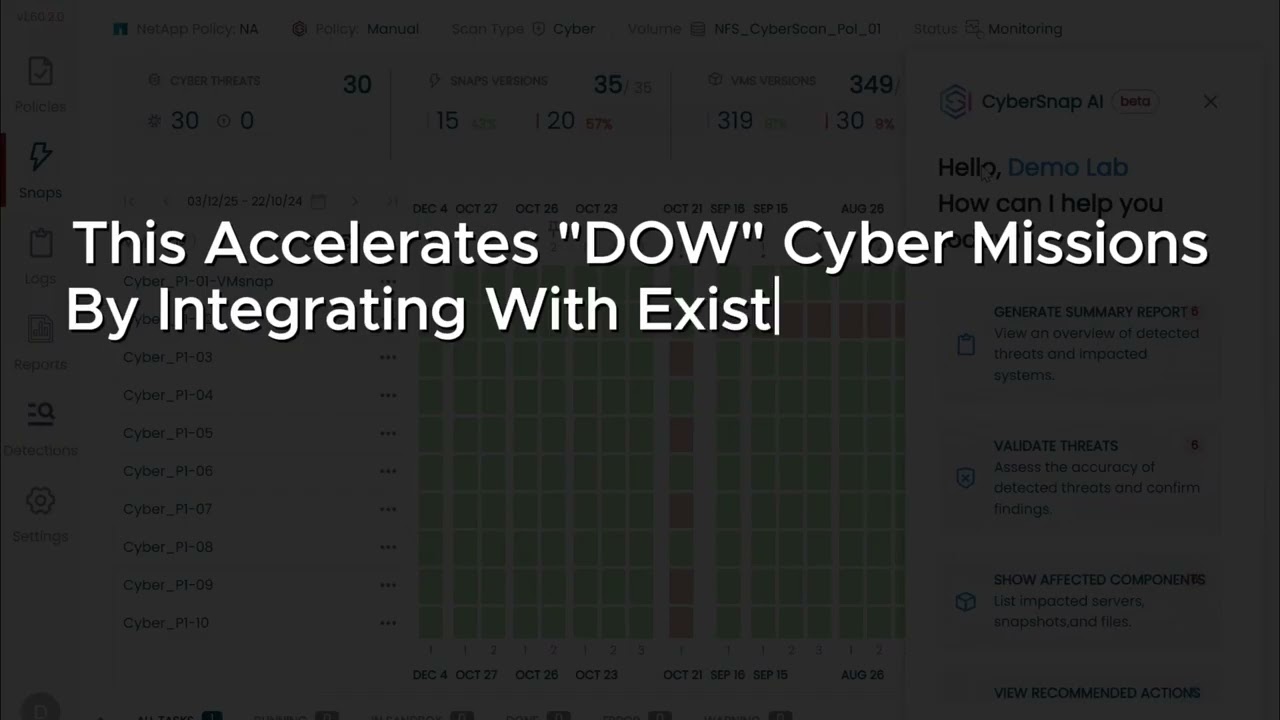
Live SnapMap scan of a typical 24-hour snapshot window. The Recovery Integrity Layer engine sweeps every snapshot, validates each one offline, and identifies the latest candidate recovery point before adversary compromise. Recovery decisions become evidence-based.
CISA explicitly warns that adversaries target backups and advises validating backups before restoration. In practice, recovery teams restore quickly without sufficient validation, risking the reintroduction of dormant malware, ransomware artifacts, or compromised credentials hidden in historical recovery data. The result: repeat compromise, cascading failures, and extended mission downtime at the moment recovery is supposed to restore control.
Recovery Integrity Layer validates recovery points before restore, rather than assuming backups are clean. The engine operates offline and read-only. It is designed to support air-gapped, contested, or degraded environments. It produces evidence-based confidence on which recovery points are candidates for restoration, which are higher-risk, and which are likely to fail operationally, so responders act on evidence rather than assumption.
Engine touches recovery data only for inspection. No write actions. Designed to support isolated, air-gapped, contested, or degraded recovery environments.
Each snapshot gets a clean / suspicious / compromised verdict with confidence. Operators see which restore points carry forward risk.
Identifies the latest candidate recovery point before adversary compromise. Selecting a validated recovery point can reduce the risk of reintroducing known compromise during restoration.
The pattern in federal cyber recovery is "restore first, hope second." CISA guidance is explicit: validate backups before restoration. The Recovery Integrity Layer reduces the guesswork. Built with a U.S.-controlled codebase, architecture, and AI-driven decision support tailored to DoD recovery workflows. Customer-operated and release-stage status used only where verified.
A visual preview of the Recovery Integrity Layer pre-restore validation workflow. An updated demonstration video will be published here.
Planned U.S.-built federal variant positioned for controlled pilot evaluation. Customer-operated and release-stage status used only where verified.
NSA / DIB Cyber. DoD Cyber Resilience. TSM Awardable where verified. OTA recovery pilots. Incident response integrators. Backup and storage partners.
SDVOSB subsystem fit for primes serving federal recovery, IR, and backup-stack programs. Reduces capture burden in federal recovery modernization.
Federal cyber recovery teams, NSA/DIB programs, backup/storage primes, IR integrators: tell us the recovery posture. Axirix tailors the package to your evaluation criteria.