
Eight Mission Systems. Eight Defined Defense Problems.
Each Axirix mission system is built around a specific operational problem. Maturity varies by system, from concept and lab-stage work to pilot-ready software. Axirix applies the same engineering discipline across the portfolio while labeling maturity conservatively and separately for each capability.
Maturity legend: Concept-stage · Lab-stage · TRL labels where verified · Architecture and planning · Planned variant · Customer-operated where verified · Release-stage where verified. Claims used only where verified.
V-01 Mission Twin
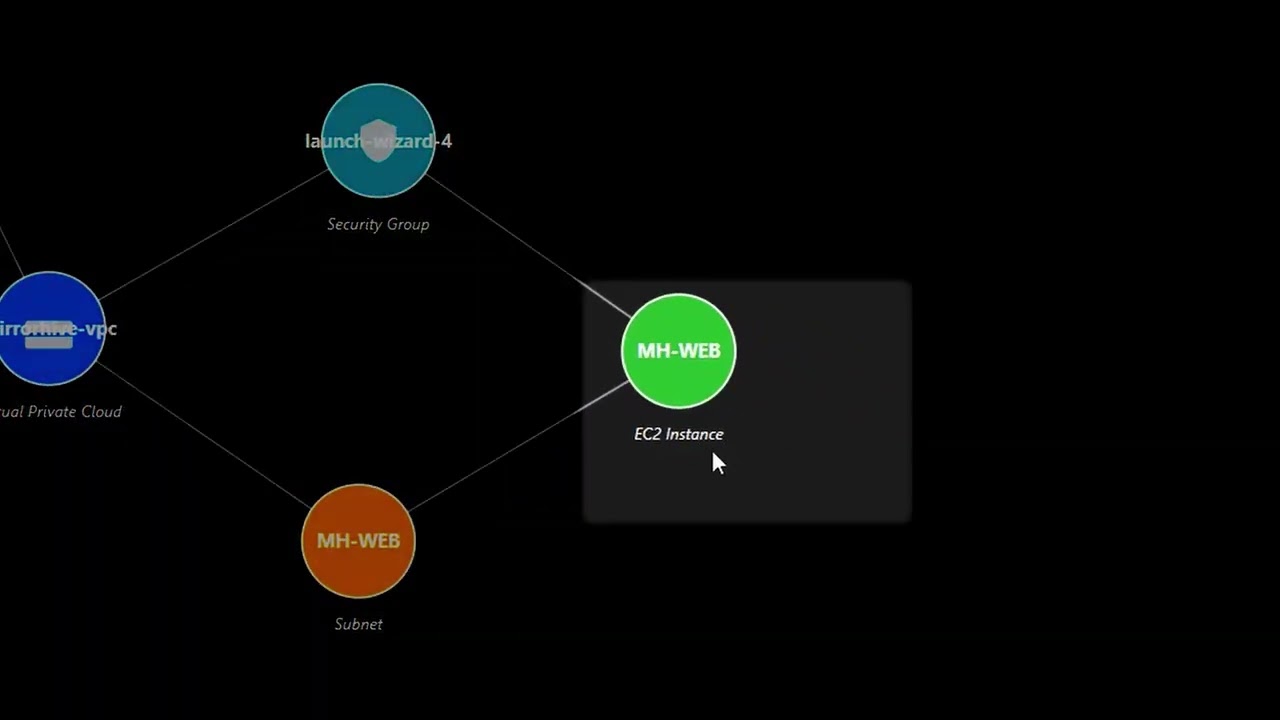
Adversaries use AI to set the pace. Penetration testing and red teaming are constrained by time, scope, and production risk. As cloud environments grow more complex, defenders cannot safely explore how attacks actually propagate across identities, services, and dependencies. Adversaries do not face these limits.
Isolated representative mission environment built through read-only discovery. Maps assets, identities, configurations, and dependencies without touching production. Inside the mirror environment, AI-assisted attack simulations exercise the system with operator and engineer review, surfacing kill chains, lateral movement, and compounding weaknesses in human-readable form. Defenders see what adversaries see, before exploitation in production.
NSA/DIB cyber, DoD cyber, CDAO, cyber ranges, TSM, OTA, AFWERX, prime cyber integration.
Shifts cyber validation from point-in-time testing to continuous, adversary-paced simulation. Removes production risk and scope limits. Closes the tempo gap by returning initiative to defenders.
V-02 PhotonTrace
Fiber-tethered UAS reduce or eliminate RF signatures, defeating RF-based counter-UAS detection. Adversaries increasingly use fiber-tethered platforms specifically to evade operator-location discovery and degrade operator-location awareness.
Non-RF sensing payload for tether detection and operator-location awareness. Uses EO/IR, LiDAR, AI sensor fusion, tether-path reconstruction, coordinate cueing, confidence scoring, and visual trace overlays. Designed for adaptation toward the Picatinny Common Lethality Interface Kit (CLIK), integrated with government-provided upper Group 2 or lower Group 3 UAS.
Army SBIR Topic ARM26BX01-NV002 (Modular Payloads for UAS), SOCOM Vulcan, SOFWERX, counter-UAS technical exchange, Blue UAS or prime integration.
Developed against the Army Modular Payloads for UAS requirement profile (ARM26BX01-NV002). Operator-informed iteration. Planning artifacts include payload architecture, interface assumptions, SWaP-C baselines, SAR inputs, vendor coordination plans, end-user touchpoint plans, and a prototype roadmap.
V-03 LumenGlaive
Autonomous robotic systems, UAS swarms, and sensor-dependent platforms are increasingly part of the contested-environment picture. Defenders need a sensing layer that surfaces threat presence, classifies behavior, and gives humans the time and confidence to decide. Generic counter-UAS systems target larger, high-signature platforms.
Counter-autonomy sensing and awareness capability. Fusion of EO/IR, LiDAR, and AI-assisted behavior classification surfaces robotic and UAS signatures in human-readable form. Output is confidence-scored, decision-support information for the operator. LumenGlaive supports counter-autonomy planning and awareness, not autonomous engagement. Human decision-making remains in the loop at every stage.
SOCOM Vulcan, SOFWERX, Army counter-autonomy, Air Force force protection, Blue UAS OEM partners, prime unmanned systems teaming, OTA prototype pilot.
Closes the sensing gap that smaller, autonomous, sensor-dependent threats slip through. Operator and engineer review at every stage. Designed for human decision support, not autonomous engagement.
V-04 Recovery Integrity Layer
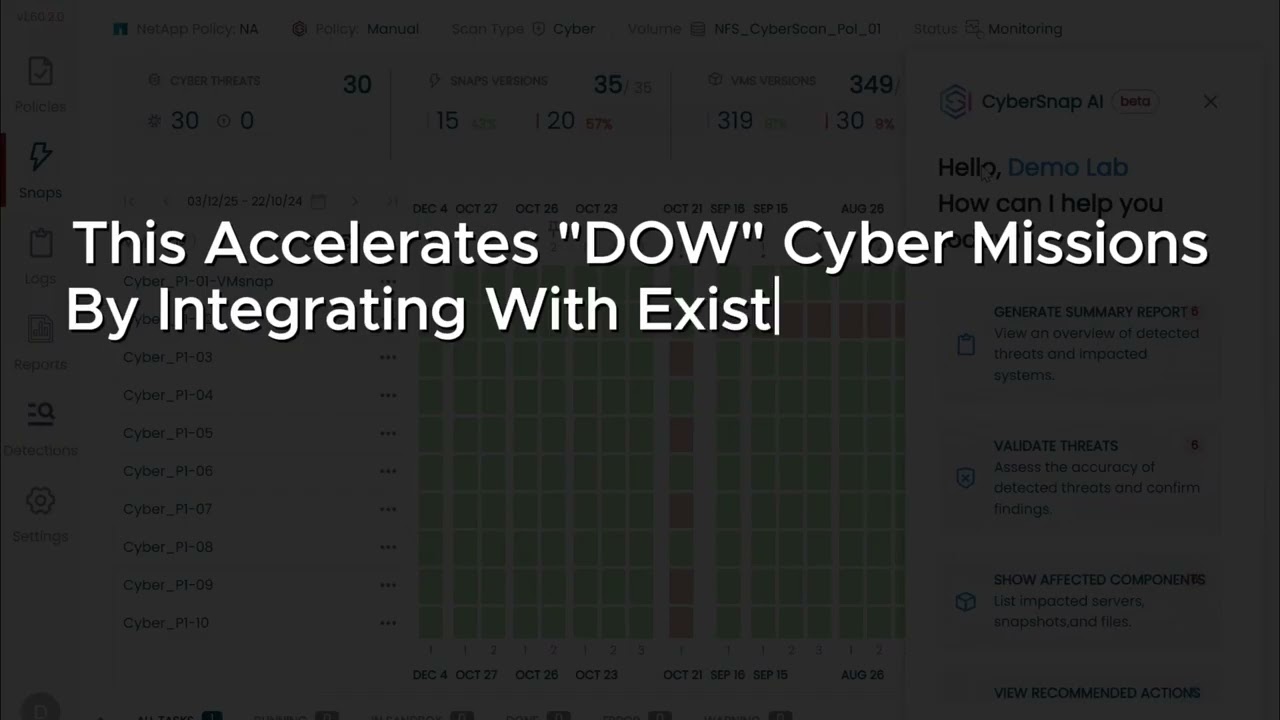
Recovery is no longer a simple restore action. It is a risk decision. CISA explicitly warns that adversaries target backups and advises validating backups before restoration. In practice, recovery teams restore quickly without sufficient validation, risking reintroduction of dormant malware, ransomware artifacts, or compromised credentials hidden in historical recovery data. Result: repeat compromise, cascading failures, extended mission downtime at the moment recovery is supposed to restore control.
Validates recovery points before restore, rather than assuming backups are clean. Operates offline and read-only. Designed to support air-gapped, contested, or degraded environments. Produces evidence-based confidence on which recovery points are candidates for restoration, which are higher-risk, and which are likely to fail operationally, so responders can act on evidence rather than assumption.
NSA/DIB cyber, DoD cyber resilience, TSM, OTA recovery pilot, incident response integrators, backup and storage partners, prime cyber teaming.
Aligns directly with CISA ransomware recovery guidance. Reduces the "restore first, hope second" pattern in mission cyber. Built with a U.S.-controlled codebase, architecture, and AI-driven decision support tailored to DoD recovery workflows.
V-05 LedgerLink ITV
Commanders need confidence in asset location, custody, route status, contents, tamper risk, and arrival times during contested operations.
Asset digital twins, identity-linked custody events, multimodal tracker assumptions, tamper alerts, predictive ETA, audit logic, and commander-facing common operating picture planning.
Army SBIR in-transit visibility, Army logistics modernization, Air Force logistics or mobility units where requirements align, OTA pilot, logistics prime teaming.
V-06 Maritime Shield
Low-cost unmanned surface vessels, explosive drone boats, can damage or sink billion-dollar warships. Adversaries deploy swarms of autonomous or remotely-piloted vessels to overwhelm traditional defenses. Missiles are expensive. Guns require constant human engagement. Reaction time is shrinking. The Navy needs persistent, automated perimeter defense for ports, carrier strike groups, tankers, and forward operating bases.
A concept for tethered unmanned maritime nodes positioned around a protected vessel or facility. The architecture is designed to extend sensing, maintain persistent power and data connectivity through physical tethering, and provide distributed situational awareness against low-cost unmanned surface threats. Tethered nodes can reduce reliance on wireless control links and may support persistent host-supplied power and data connectivity, subject to engineering validation. Response options remain subject to platform, mission, safety, rules-of-engagement, and government requirements.
Navy, SOCOM maritime, Coast Guard, port security, maritime primes, OTA pilot, SOFWERX maritime experimentation, DARPA maritime programs.
Distributed sensing across multiple tethered nodes is intended to improve coverage and coordinated awareness around the host platform. Potential use cases include high-value vessels, ports, and offshore infrastructure, subject to engineering validation.
V-07 BattleForge Hub
The Department of Defense faces a persistent gap between mission demand and accession throughput for cyber, AI, electronic warfare, and intelligence roles. Traditional recruiting, fitness screening, and clearance processing operate as fragmented lanes, creating delays, attrition, and uneven candidate quality, especially when physical readiness, technical preparation, and eligibility requirements are not addressed as a unified system.
A structured, repeatable pipeline that moves applicants from intake through assessment, remediation, technical upskilling, and pre-screened candidate packaging for recruiter action. Hub-based model emphasizes consistent standards, measurable progress, and scalable throughput across diverse communities. Integrates physical readiness preparation, mission-relevant technical training, and administrative-readiness workflows into a single end-to-end pathway. Security-clearance eligibility, investigation, and adjudication remain solely within authorized U.S. government processes.
DoD talent acquisition, service-level personnel commands, NAVWAR PEO Digital (DCWF-aligned workforce), Army cyber workforce programs, SOFWERX talent programs, OTA pilot, prime workforce-services teaming.
Reduces friction between accession steps. Improves speed and quality of candidate delivery. BattleForge is structured as a potential pipeline-service model that could support government or prime workforce requirements where authorized and funded, including hub operations, instruction capacity, readiness infrastructure, and secure talent dashboard access.
V-08 Data Integrity Guard
Poisoned, stale, inconsistent, or compromised data can drive bad decisions across AI, cyber, logistics, and mission planning.
Surfaces anomaly patterns, provenance gaps, poisoning risk, drift, inconsistent records, and confidence breaks before data drives decisions.
NSA AI Security Center, DoD cyber, CDAO, DIB cyber, trusted AI programs, TSM, SBIR, prime AI integration.
Route the Right Mission System to the Right Pathway
Each mission system is engineered around the requirement, and structured for the pathway that can evaluate, transition, or acquire it.